In this post I will be discussing the development of
effective groups. I will also be analysing some theories of leadership.
There have been many definitions of group cohesion the most
comprehensive definition is be Carron, Brawley and Widmeyer (1998). They
defined cohesion as “a dynamic process that is reflected in the tendency for a
group to stick together and remain united in pursuit of its instrumental
objectives and/or for the satisfaction of members affective needs,” Weinberg
and Gould (2011, p180). This shows that group cohesion can change over time and
group cohesion is created for a reason within a group.
The attraction and liking of group members is important to
group cohesion because if you have attraction between members of the group,
then they will participate in a task as a group but because they might not like
one member of the group they will not involve that individual in the task. E.g.
In football a small group of players might not like some other players on the
team so when playing in a match they might not pass to them, even if it could
help the team succeed. Therefore to be a more successful as a group it needs
attraction, by members, to the group as a whole. This makes each individual
feel involved in the team/group and would feel more trust and desire to
participate for each other as a team.
Carron offered four factors that could affect cohesion,
(development and growth), they are: “Environmental factors could include
scholarships, contracts, eligibility, family expectations. Personal factors
could include social background, personality, gender, attitude, etc. Leadership
factors could include communication, goals, roles. Team factors could include
group norms, task/social cohesion,” (Gill, A. 2012). Carron says that “Team
Cohesion = the degree to which members of a group work together to achieve
common goals, and Social Cohesion = reflects the degree to which members of a
team like each other and enjoy each other’s company,” M.Collins.
To help with
development of the group the group needs unity and teamwork within it. With
unity you could have group unity which is everyone stick together as members
‘cohere’ to one another and the group itself. You can also have belonging to a
group where “members report feeling a sense of belonging to a group,’ (Gill, A. 2012). Teamwork can consist of
collective efficacy or esprit de corps which is group morale and the feeling of
unity commitment. Both teamwork models will lead to cohesion within the group.
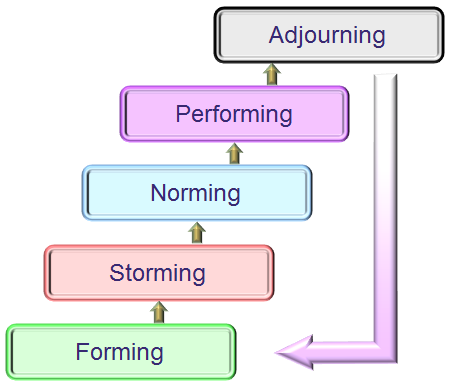
Cohesion doesn’t happen straight away within teams it happens over time. Tuckman developed a five-stage model of group development. “Orientation (forming) stage, Conflict (storming) stage, Structure development (norming) stage, Work (performing) stage, Dissolution (adjourning) stage (planned and unplanned),” (Gill, A. 2012). Forming is the start of a group/ teams life as it is where people come together to start up the group/team. This stage will often have tension between members as well as low levels of interaction between members. Storming is where there is a high level of tension and conflicts start to occur between members of the group. It will also lead to the fight or flight response from members as well as creating team cohesion. Norming is the stage where the group becomes more organised, the support increases as well as communication. Also rules, roles and goals of the group are established between each member. Performing this is not an instant thing and will only get better over time as the groups mature. A problem with this stage is that some groups get sidetracked by the storming and norming phases. The final stage is Adjourning this is planned or unplanned and would normal happen after the goals of the group have been achieved. It could be a stressful time for some members of the group as what they have done is coming to an end.
The consequences of cohesion are it tends to lead to
increased satisfaction between members and turnover and stress are decreased.
So “Cohesion-performance relationship is bi-directional: success increases a
group’s cohesion, and cohesive groups tend to outperform less cohesive groups.”
There are many different theories of leadership. Leadership
is “the process whereby an individual influences a group of individuals to
achieve a common goal,” Weinberg and Gould (2011, p203).
The first theory was developed in 1920 and is called ‘Trait
Approach’ this was the first really look at leaders and trying to find out what
types of traits they have. The researchers suggested that good leaders tend to
have “relatively stable personality dispositions, such as intelligence,
assertiveness, independence, and self-confidence,” Weinberg and Gould (2011,
p204). This suggested that successful leaders are more likely to be leaders in
different situations. So a leader in a sports team could change sport/team and
still be a leader in that different sport/team. However after the Second World
War Stogdill (1948) reviewed the trait theory and found only a couple of the
leaders have consistent personality traits. This theory is not really used
anymore and doesn’t give an accurate take on qualities from leaders. In the
storming stage of a team or a group I think that you could use this theory to
show the outcome as people are fighting for dominance within the group so the
leader’s assertiveness, independence and self-confidence are shown.
The ‘Behaviour Approach’ is another leadership theory and
this suggests that anyone can become a leader. This theory is unlike the trait
theory because this one suggests that leaders are made not born. It also
suggest that you could become a leader “by simple learning the behaviours of
other effective leaders,” Weinberg and Gould (2011, p205). This theory is good
in sport as a coach can show their players what they need to do to be leaders
and the can players can then put these demonstrations in to practise to become
more successful. John wooden was a basketball coach and “researchers noted that
his demonstrations rarely lasted longer than 5 seconds, but they were so clear
that they left an image in memory, much like a textbook sketch,” Weinberg and
Gould (2011, p206).
‘Situational Approach’ is a third leadership theory that
argues that leader characteristics are not as important as first thought. This
theory thinks that to have effective leadership is more dependent on characteristics
of the situation than on the traits and behaviour of the leader in those situations.
So “Situational influences thus
constrain the leader who must adapt his or her style of leadership to the
situation at hand,” Sirje Virkus (2009). If I relate this theory to group
cohesion and to the stage of ‘storming’ then you could say that if a team is
put together that has no obvious leader, then at this stage due to the
situation a leader might appear from the group because the situation requires
someone to take the lead. This link, https://www.youtube.com/watch?v=QbS3samTsOA, by mattalanis shows and explains how situational leadership works and what people do to make it work.
The fourth leadership theory is ‘Interactional Approach’. This
theory looks at how people interact with each other which as led to many
different models for this theory. It also takes into consideration for both
people and environmental or situational factors. Weinberg and Gould (2009,
p209) says “the effectiveness of an individual’s leadership style stems from
matching the style to the situation.” This would mean that you could be the
best leader but put in to a situation that you don’t feel comfortable in then
it would take time to be a good leader in that situation as you try to find the
best style for your leadership to be successful.
In this report I have discussed the development of effective
groups and different leadership theories with references from different sources
to support what I have wrote.
References
Gill, A., 2012, Group Cohesion, Unit 2 Sport & Exercise Psychology, Chesterfield College, unpublished.
M.Collins (n.d) Group
Cohesion, [Online] Available from: http://www.lcsc.edu/mcollins/groupcohesion.htm,
[Accessed 30th December 2012].
Sirje Virkus (2009)
Leadership Models – Situational Approach, [Online] Available from: http://www.tlu.ee/~sirvir/Leadership/Leadership%20Models/situational_approach.html,
[Accessed 30th December 2012].
Weinberg and Gould (2011) Foundations of Sport and Exercise Physiology, (ed. 5), United
States of America, Human Kinetics.

Sport Psychology: Regarding team cohesion, can you explain and analyse the phenomenom of social loafing? Using appropriate examples to support your findings. Also, provide a solution to reduce the effect that social loafing may have on a teams performance.
ReplyDeleteAlso as a way of improving this blog, link in any relevant videos (YouTube)/diagrams/academic papers/audioclips that support the key points made in this blog.
Group Cohesion: danielbagley.blogspot.co.uk/
ReplyDeleteThis blog discussed the development of effective groups by referring to Tuckman’s (1965) theory of group development and Carron’s (1982) antecedents to effective group formation. Examples could have been more frequent and numerous to ensure that you can accurately place the concepts and theories in context and relate them to sports performance. Leadership theories have been introduced and briefly analysed in the blog.
This assessment has met the criteria to pass, however, I feel that your blog could have been much more dynamic and far more sources should have been consulted to provide a more in-depth understanding of the topic. At the moment there is little evidence of a wide-range of reading around the subject.
Nice post about leadership theories and Group Cohesion. I always love the "I can" or positive way of thinking. Thanks!!!
ReplyDelete